Discover what Emgality® can do for patients with chronic migraine1

Actor portrayal
For your patients with ≥15 headache days per month1
Emgality reduced mean monthly MHDs1
Emgality prevented significantly more mean monthly MHDs vs placebo1a:
- REGAIN: 4.8 with Emgality 120 mg (N=273) vs 2.7 with placebo (N=538) (baseline mean: 19.4 vs 19.6) over Months 1 to 3 (p<0.001)
Emgality demonstrated a reduction in MHDs in the first month and every following month1
Mean Change From Baseline in Monthly MHDs1,2a
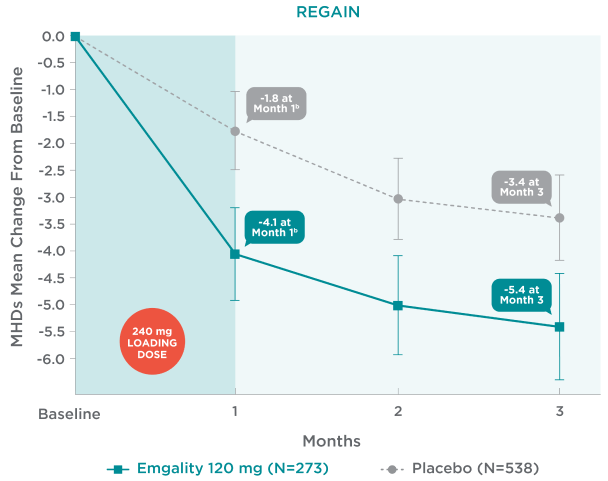
aLS means and 95% confidence intervals are presented.1-3
bEarliest post-baseline, prespecified assessment.
In REGAIN, mean change from baseline in monthly MHDs with Emgality 120 mg (N=273) plus 240 mg loading dose vs placebo (N=538), respectively1,2a:
- Month 1: -4.1b vs -1.8b
- Month 2: -5.0 vs -3.0
- Month 3: -5.4 vs -3.4
No formal hypothesis testing was conducted to evaluate treatment difference in mean monthly MHD reduction at each month. However, patients treated with Emgality 120 mg showed a nominally greater reduction in number of monthly MHDs at each month compared to placebo.1,2
See study design for REGAIN .
See MHD data for episodic migraine .
SELECT IMPORTANT SAFETY INFORMATION
Raynaud’s Phenomenon
Development of Raynaud’s phenomenon and recurrence or worsening of pre-existing Raynaud’s phenomenon have been reported in the postmarketing setting following the use of CGRP antagonists, including Emgality. In reported cases with monoclonal antibody CGRP antagonists, symptom onset occurred after a median of 71 days following dosing. Many of the cases reported serious outcomes, including hospitalizations and disability, generally related to debilitating pain. In most reported cases, discontinuation of the CGRP antagonist resulted in resolution of symptoms.
Emgality should be discontinued if signs or symptoms of Raynaud’s phenomenon develop, and patients should be evaluated by a healthcare provider if symptoms do not resolve. Patients with a history of Raynaud’s phenomenon should be monitored for, and informed about the possibility of, worsening or recurrence of signs and symptoms.
For your patients with ≥15 headache days per month1
With Emgality, a significantly greater mean percentage of patients achieved a ≥50% reduction in monthly MHDs from baseline vs placebo (p<0.001)1
≥50% Reduction of Monthly MHDs From Baseline vs Placebo Over Months 1 to 31
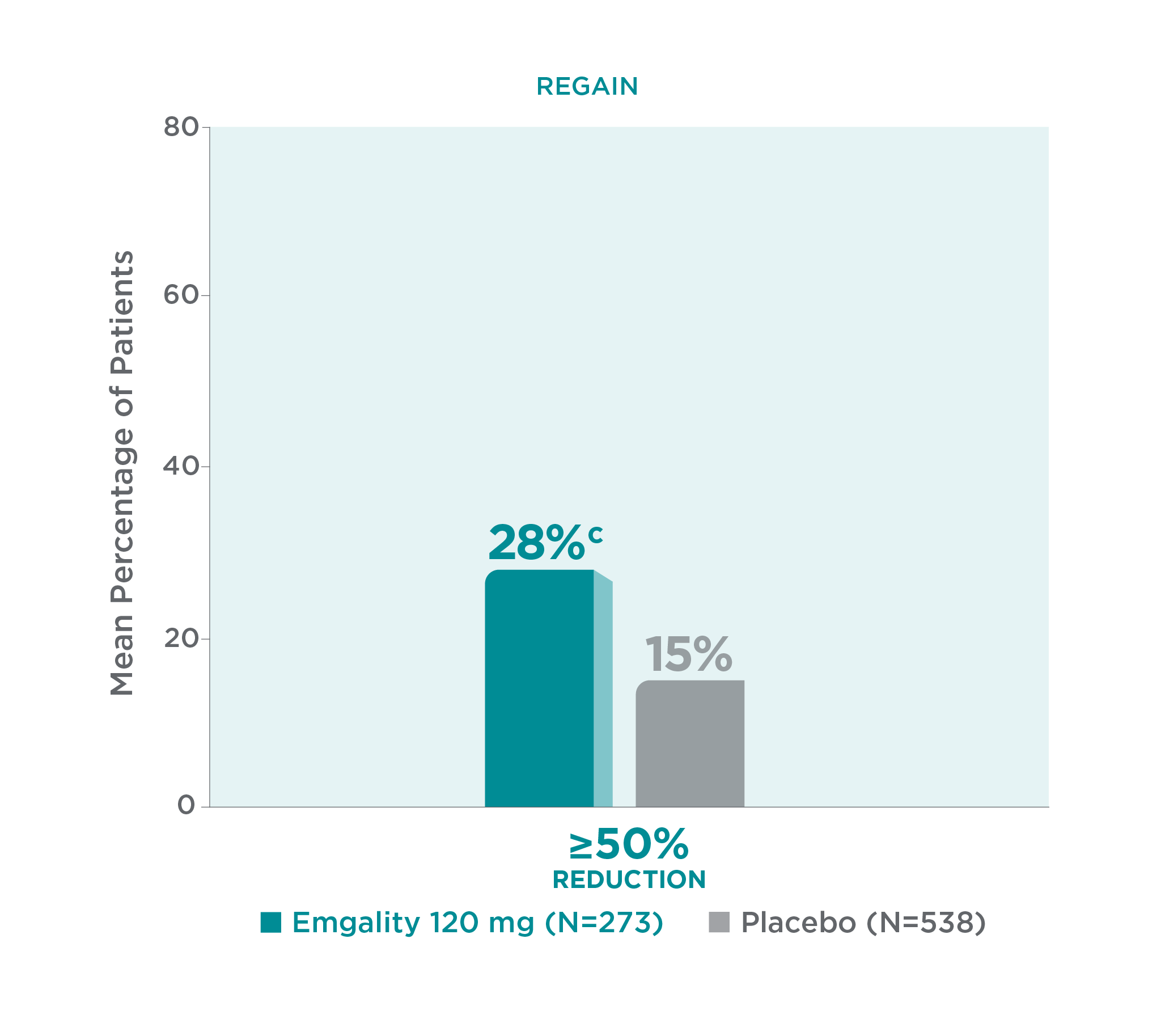
cp<0.001 vs placebo.1
LS=least-square; MHD=migraine headache day.
Twenty-eightc percent of patients with chronic migraine taking Emgality 120 mg (N=273) achieved a ≥50% reduction in monthly MHDs from baseline vs 15% with placebo (N=538) over Months 1 to 3 (p<0.001).1
In REGAIN, Emgality 120 mg was not significantly better than placebo for the mean percentage of patients with ≥75% or 100% reduction from baseline in the number of monthly MHDs over the 3-month treatment period.1
See study design for REGAIN .
See response rate for EVOLVE-1 and EVOLVE-2 .
SELECT IMPORTANT SAFETY INFORMATION
Adverse Reactions
The most common adverse reactions (incidence ≥2% and at least 2% greater than placebo) in Emgality clinical studies were injection site reactions.
References
- Emgality. Prescribing Information. Lilly USA, LLC.
- Data on File. Lilly USA, LLC. DOF-GZ-US-0002.
- Data on File. Lilly USA, LLC. DOF-GZ-US-0120.