For your patients with 4-14 MHDs per month
Emgality significantly improved patients' migraine-specific quality of life during and in between attacks1,2
MSQ v2.1 RF-R scores are scaled from 0 to 100. Higher scores indicate less impact of migraine on daily activities.1
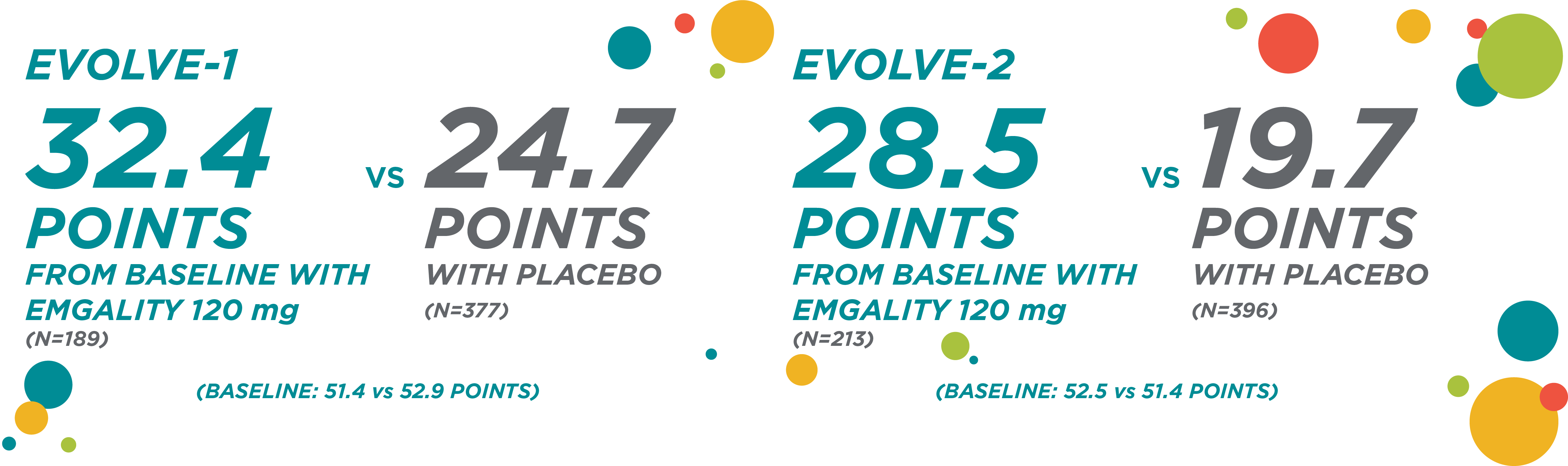
On the MSQ v2.1 RF-R, Emgality demonstrated a significantly greater mean improvement from baseline vs placebo over Months 4 to 6.1
ap<0.001 vs placebo.1
- In EVOLVE-1, mean improvement from baseline in MSQ RF-R scores for Emgality 120 mg (N=189) was 32.4 points vs 24.7 points with placebo (N=377) over Months 4 to 6. Baseline values for Emgality and placebo were 51.4 vs 52.9 points, respectively.
- In EVOLVE-2, mean improvement from baseline in MSQ RF-R scores for Emgality 120 mg (N=213) was 28.5 points vs 19.7 points with placebo (N=396) over Months 4 to 6. Baseline values for Emgality and placebo were 52.5 vs 51.4 points, respectively.
In REGAIN, statistical significance vs placebo was not observed after controlling for multiple comparisons for mean change in MSQ v2.1 RF-R.1
See study designs for EVOLVE-1 and EVOLVE-2 and REGAIN .
SELECT IMPORTANT SAFETY INFORMATION
Hypertension
Development of hypertension and worsening of pre-existing hypertension have been reported following the use of CGRP antagonists, including Emgality, in the postmarketing setting. Some of the patients who developed new-onset hypertension had risk factors for hypertension. There were cases requiring initiation of pharmacological treatment for hypertension and, in some cases, hospitalization. Hypertension may occur at any time during treatment but was most frequently reported within 7 days of therapy initiation. Emgality was discontinued in many of the reported cases.
Monitor patients treated with Emgality for new-onset hypertension or worsening of pre-existing hypertension, and consider whether discontinuation of Emgality is warranted if evaluation fails to establish an alternative etiology or blood pressure is inadequately controlled.
MHD=migraine headache day; MSQ v2.1=Migraine-Specific Quality of Life Questionnaire version 2.1; RF-R=Role Function-Restrictive.
References
- Emgality. Prescribing Information. Lilly USA, LLC.
- Speck RM, Shalhoub H, Wyrwich KW, et al. Psychometric validation of the Role Function Restrictive domain of the Migraine Specific Quality-of-Life Questionnaire Version 2.1 electronic patient-reported outcome in patients with episodic and chronic migraine. Headache. 2019;59(5):756-774.